Finding · May 26, 2026
The 1888 Rebrand
For years the site said Windsor Place was renamed from Braxton Street “around 1900, in a mysterious administrative swap that has never been officially explained.” In May 2026 a neighbor shared an article that fixes the date by twelve years and reveals the swap was part of a deliberate pattern.
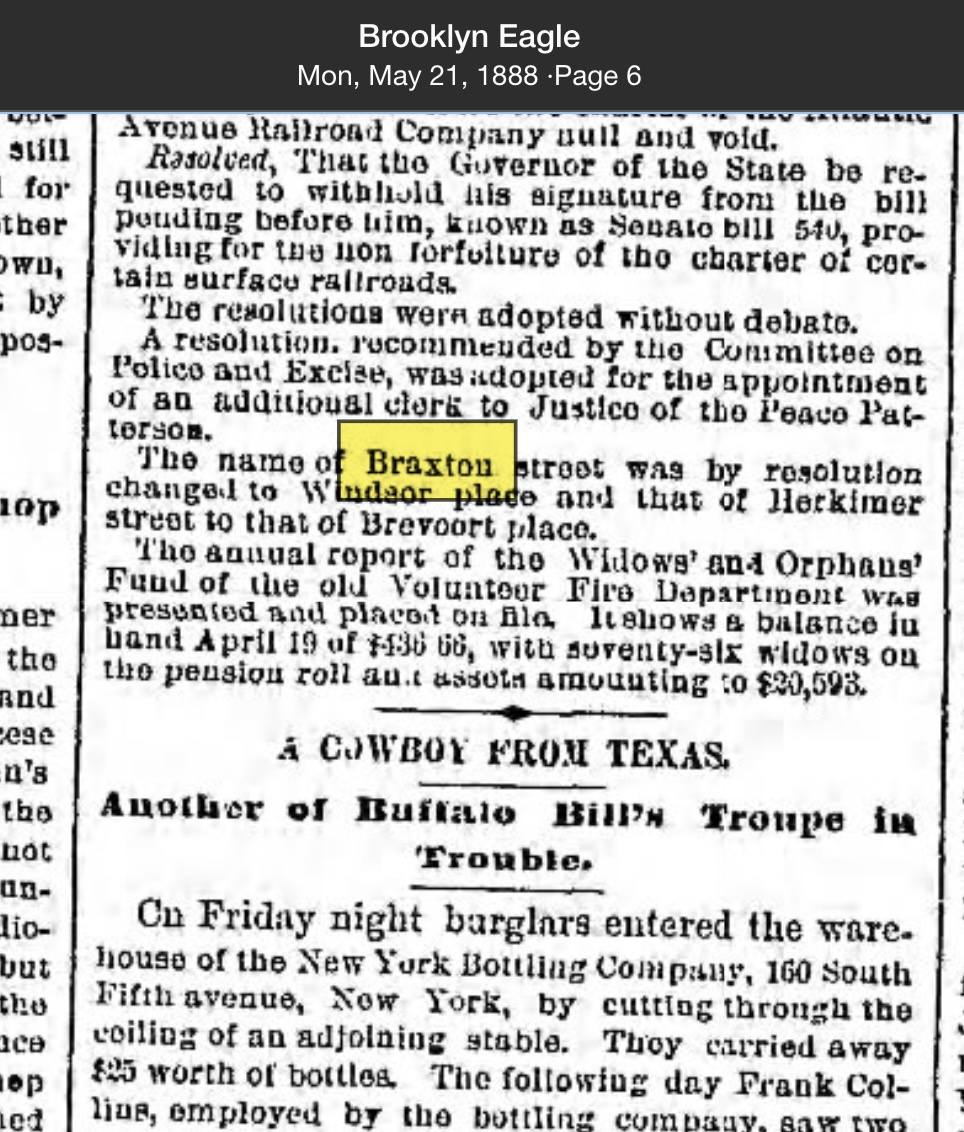
The relevant paragraph
“The name of Braxton street was by resolution changed to Windsor place and that of Herkimer street to that of Brevoort place.”
— Brooklyn Eagle, May 21, 1888, p.6
What this overturns
The date was 12 years off. For years the site — quoting Forgotten NY's Kevin Walsh — gave “around 1900” with no source. The 1888 article is the Council's own action. The rename happened on May 21, 1888.
It was a formal Common Council resolution, not a quiet administrative shift. There was a vote.
It wasn't one street — it was two, in the same vote. Braxton became Windsor Place AND Herkimer became Brevoort Place in the same Council action. That paired-rename pattern is the smoking gun.
The Brooklyn Eagle wasn't the only paper to report it. An independent corroboration of the May 21, 1888 vote appears the next morning in the New-York Tribune, May 22, 1888, page 8, in a brief news roundup that lists, side by side: “the aldermen yesterday changed the names — braxton windsor place and herkimer brevoort place.” Found in May 2026 via a sweep of the Library of Congress Chronicling America archive. Two separate New York papers, two separate newsrooms, both reporting the same Brooklyn Aldermen vote within 24 hours.
The cartographic confirmation arrives within 12 months. The 1889 “Map of Brooklyn, Engraved Expressly for the Standard World Atlas” (David Rumsey collection 4727.068) labels the street as “Windsor Pl.”— and Braxton Street appears nowhere on the map. By the spring of 1889, less than ten months after the vote, the new name had propagated into commercial cartography. The atlas was OCR'd via Gemini 2.5 Pro on Vertex AI on May 29, 2026; full extraction at research/standard-1889-extraction.json. Curiously, the same map still labels “Herkimer” rather than “Brevoort Place” — the cartographer caught one of the two paired renames but not the other.
The pattern: an aristocratic rebrand
Two utilitarian American street names, swapped in a single Council vote for two prestige names. “Windsor” from the English royal house. “Brevoort” from the old Dutch-NYC patrician family that owned much of lower Manhattan and gave Brevoort Place and Brevoort Hotel their names. Both choices are aspirational naming, not commemorative naming — nobody in 1888 Brooklyn was named Windsor or Brevoort.
The same pattern shows up across the neighborhood's naming history in the 1880s and 90s. The neighborhood itself was already “Windsor Terrace” (named in 1849 by William Bell after Windsor, England). The block immediately south was given the English place-name “Kensington” in the same era. A short stretch of 16th Street between Prospect Park West and Prospect Park Southwest had previously held the name “Windsor Place” — it lost that name and reverted to plain 16th Street.
Why the rebrand? A May 2026 community contribution from a Windsor Place neighbor framed it as “real estate shenanigans” — developers and the city raising rents and the social register of the neighborhood by replacing vernacular names with names that sounded English and aristocratic. The May 21 1888 article reports the resolution but does not editorialize on motive, so we mark the “why” as consistent with the documented pattern but not directly cited.
Why our newspaper sweep missed it
The first instinct when checking a date claim is to count mentions of the old name in the newspaper archive and watch for the transition. Our Brooklyn Eagle sweep shows “Braxton Street” mentions continuing all the way through 1904, peaking again that year before disappearing. That suggested the rename happened around 1904–1907.
That logic is wrong. Newspapers and residents kept using “Braxton” for years after the legal change — the same way New Yorkers still say “Idlewild” for JFK or “the Triboro” for the RFK Bridge. The legal date and the colloquial-use date are different curves. The article about the rename is authoritative; the trailing mention-frequency is just lag.
The 1888 Eagle article didn't come up in our keyword sweep because the OCR for that specific page is weak in newspapers.com's index. The neighbor had read it in person. The same Council resolution was reported in the sister paper, the Brooklyn Daily Times, on page 1 the same morning — and that version is indexed (see Sources, below).
Sources
- Brooklyn Eagle, May 21 1888, p.6 — the rename article (clipping above). Not directly linkable from newspapers.com because the page's OCR is incomplete; the clipping image is preserved on this site at
/findings/1888-braxton-to-windsor-clipping.jpg. - Brooklyn Daily Times, May 21 1888, p.1 — same-day primary source. newspapers.com/image/555768645
- Brooklyn Daily Times, May 23 1888, p.2 — echo coverage of the resolution. newspapers.com/image/557017409
- Sanborn Fire Insurance Map of Brooklyn, 1888 (NYPL) — the architectural snapshot of the block at the moment the rename happened. digitalcollections.nypl.org
- Kevin Walsh, Forgotten NY (2016) — the long-standing documentation that the swap happened, before the date was found. forgotten-ny.com
- Brooklyn Public Library map archive, 1869 / 1880 / 1886 / 1898 / 1903 — sequential maps showing the street label progression. Shared by a Windsor Place neighbor via Dropbox.
- The neighbor contribution itself, a Facebook community post from May 2026, surfaced both the clipping image and the motive framing.
Related on this site
- Chapter 2 — Birth of Windsor Place (now reflects the 1888 date, not “around 1900”)
- Decades: 1880s (the rename now anchors the 1880s narrative)
- 35 Windsor Place — the Artz family has owned that house since 1921, 100+ years after the block stopped being “Braxton.”