1840s
2 press mentions →Papers covering the block this decade
Brooklyn Evening Star: 2
The block, decade by decade
Everything we’ve found about Windsor Place, grouped by decade — newspaper coverage, family arrivals, where spouses came from, and the archive items that capture that decade.
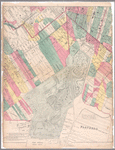
The founding decade. On April 18, 1854, Anthony Bleecker — New York's leading real-estate auctioneer of the period — sold off 800 building lots at the Merchants Exchange in Lower Manhattan. The sale, advertised across the New York Herald, Sunday Dispatch, and New-York Daily Tribune, described two adjoining tracts: lots in the 8th Ward of the City of Brooklyn (a separate municipality at the time), AND the whole of a previously-subdivided tract called Windsor Terrace, in the Town of Flatbush, on both sides of Seeley and Vanderbilt Streets, fronting the Coney Island Plank Road. This is the earliest documented use of the name Windsor Terrace — 34 years before the 1888 Braxton-to-Windsor Place rename. See /findings/windsor-terrace-founding-1854.
Construction of Prospect Park (1866-1873) repositions the rural Town-of-Flatbush land into something a Brooklyn city resident would want. In November-December 1869, Charles Courter Esq holds another auction at the Exchange Salesroom on Broadway — peremptory sale of lots on 10th-11th Avenues, 17th-19th Streets, Brooklyn and Seeley, Windsor Terrace, Flatbush. The auction notice runs in the NY Tribune every single day from November 29 through December 9, 1869 — the longest sustained newspaper marketing campaign for Windsor Terrace land we have on record.
The first row houses go up. Brooklyn city directories (Lain's, BPL via IA) document 11-27 Braxton Street residents annually from 1880 through 1887. By August 1882, a group of Windsor Terrace residents organized enough to petition the Prospect Park commissioners to reopen a gate at Fifteenth Street and Seeley (denied, NY Tribune Aug 4 1882). On May 21, 1888, a Brooklyn Common Council resolution renames Braxton Street to Windsor Place, paired in the same vote with Herkimer Street becoming Brevoort Place — confirmed in both the Brooklyn Eagle and the next-day New-York Tribune. Two utilitarian names swapped for two prestige names in a single Council action, borrowing the existing area name 'Windsor' from the 34-year-old Flatbush subdivision.
The block fills in. The Irish wave begins. The Brooklyn Daily Eagle starts running regular wedding notices from Windsor Terrace addresses — the May 1885 Brooklyn Eagle marriage record is the earliest Eagle wedding we've found from the block. NY Sun and NY Evening World between them run hundreds of Windsor-Place classified ads through the 1890s, the densest decade in the entire LoC chronam corpus (516 hits across NY-metro papers).
Upington's General Directory replaces Lain's in 1902. The street name 'Windsor Place' appears in the directories alongside the older 'Windsor Terrace' designation. William L. Calder is building two-family houses by the hundred a few blocks north. December 29, 1900: George and Apolonia Riegel deed a 23-foot row-house lot on Greenwood Avenue to Emma B. Riegel for one dollar — the deed (Columbia University Libraries, Liber 7 of Conveyances Page 674) refers to the area as the 'Windsor Terrace District'. See /findings/riegel-deed-1900.
The neighborhood crystallizes. The 1920 federal census lists everyone at every address on the block — the NARA scans for Kings County Enumeration District 1696 are linked from /census. The Irish wave is now established; the Italian wave is starting to arrive.
Peak coverage. The 1922 Brooklyn Daily Eagle had the densest neighborhood reporting of any year in the archive — 3,246 mentions of Windsor Pl/Terrace in a single year. The 1924 phone directory captures the moment when private telephones became affordable for Windsor Place families. The local exchange was HUG enot (an Anglicized clipping of Huguenot), the prefix that paired Park Slope and Windsor Terrace until the city moved to seven-digit dialing in the 1960s.
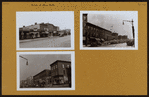
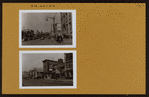
The 1930 phone directory lists 118 households on Windsor Place — the saturation snapshot. The 1930 photograph of 11th Ave and Windsor Pl (NYPL) is the earliest known photo of the block. McCarthy and Keenan families are confirmed at specific addresses by cross-reference between the phone book and the deed chains.
WWII. The 1944 wedding notices include brides whose brothers were home on leave still in uniform. Frederick von Rodeck returned from Guam in 1946 to marry Dorothy Dowd at Windsor Terrace.
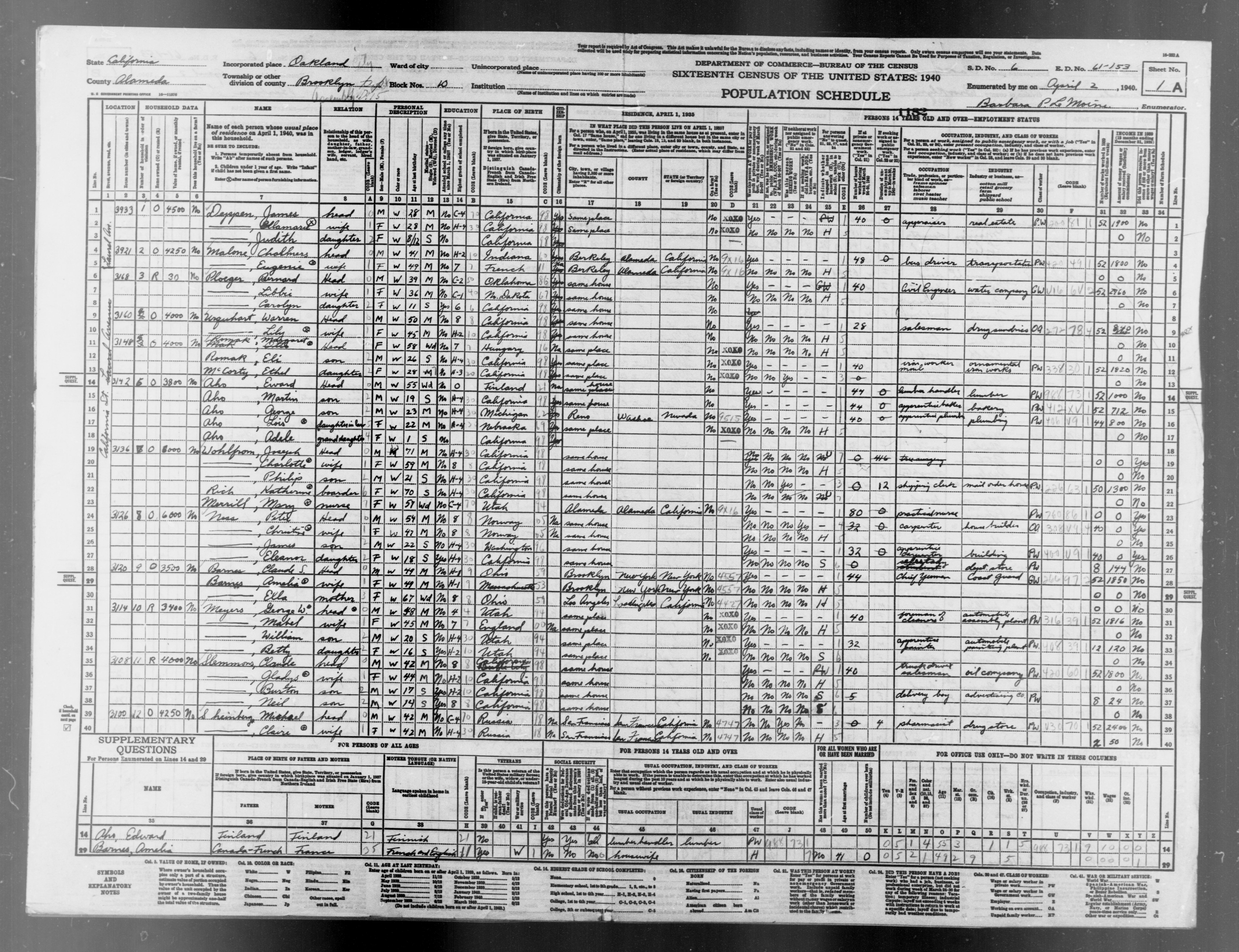
The 1950 federal census (NARA via DPLA) covers the block. The 1952 birth of Charles Alfred Gabbert Jr. at 42-A Windsor Place — with grandmother Catherine Vackner in the room — is the kind of multi-generation record that connects the early-20th-century arrivals to the families who would still own those houses in 2024.
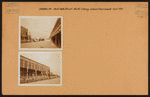
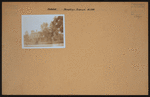
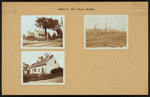
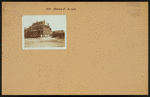
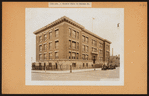
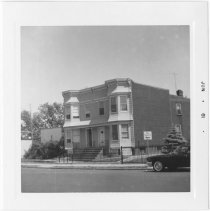
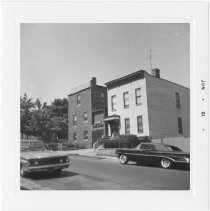
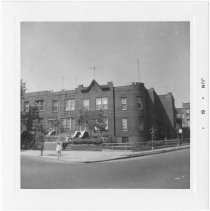
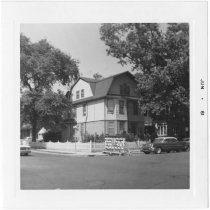
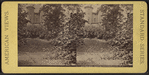
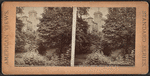
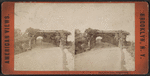
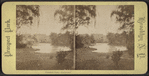
The Italian families dominate the deed chains. Empire State Digital Network has 13 street photographs from this decade.


![Brooklyn V. 3, Double Page Plate No. 65 [Map bounded by De Kalb Ave., Classon Ave., Myrtle Ave., Spencer St.]](https://images.nypl.org/index.php?t=t&id=1809133)
![Brooklyn V. 3, Double Page Plate No. 66 [Map bounded by De Kalb Ave., Spencer St., Myrtle Ave., Marcy Ave.]](https://images.nypl.org/index.php?t=t&id=1809134)

![Queens, Vol. 2, Double Page Plate No. 36; Part of Ward Two Newtown; [Map bounded by Cooper Ave., Fresh Pond Road, Cypress Hills Road; Including Fairmount St., Park Pl., Prospect St.]; Sub Plan No. 1; [Map bounded by Cypress Hill Road; Including Boundary line between the boroughs of Brooklyn and Queens]; Sub Plan No. 2; [Map bounded by Vermont Ave., Highland Boulevard, Crosby Ave.; Including Miller Ave., Miller PL., Barbey St.]](https://images.nypl.org/index.php?t=t&id=1693930)